

Networks Insight
Your organisation chart shows who reports to whom. Networks Insight shows who people actually turn to.
A short, confidential survey asks people whom they go to for advice, information and support. We turn the answers into maps and measures, then work with your leaders and staff to decide what to do about them.
Questions it answers
Every engagement starts by agreeing the questions with you. These are the ones clients ask most.
Who do people see as the real experts and influencers?
Who holds critical knowledge, and what would we lose if they left?
Who must be involved if a change is to be co-designed and to spread?
Where do teams and partners fail to connect, and who bridges the gaps?
Which talent are we overlooking for succession and new roles?
How will a merger or restructure disturb trusted relationships, and did it?
How it works
Five stages, typically over 10 to 14 weeks. You stay involved throughout, because the people who will act on the findings should help shape them.
1
Frame
Agree the questions, scope and safeguards with a small sponsoring group.
2
Ask
A confidential survey of about 15 minutes, with reminders and live tracking of who has replied.
3
Analyse
Communities, bridges, demand and spare capacity, with every pattern tested before it is reported.
4
Make sense together
A workshop around large printed maps, where staff test the findings against their own experience.
5
Act and re-measure
Agree a small number of actions, support them, and re-run the survey to see what has changed.
Worked example · fictional data
What a five-partner health and care partnership might learn
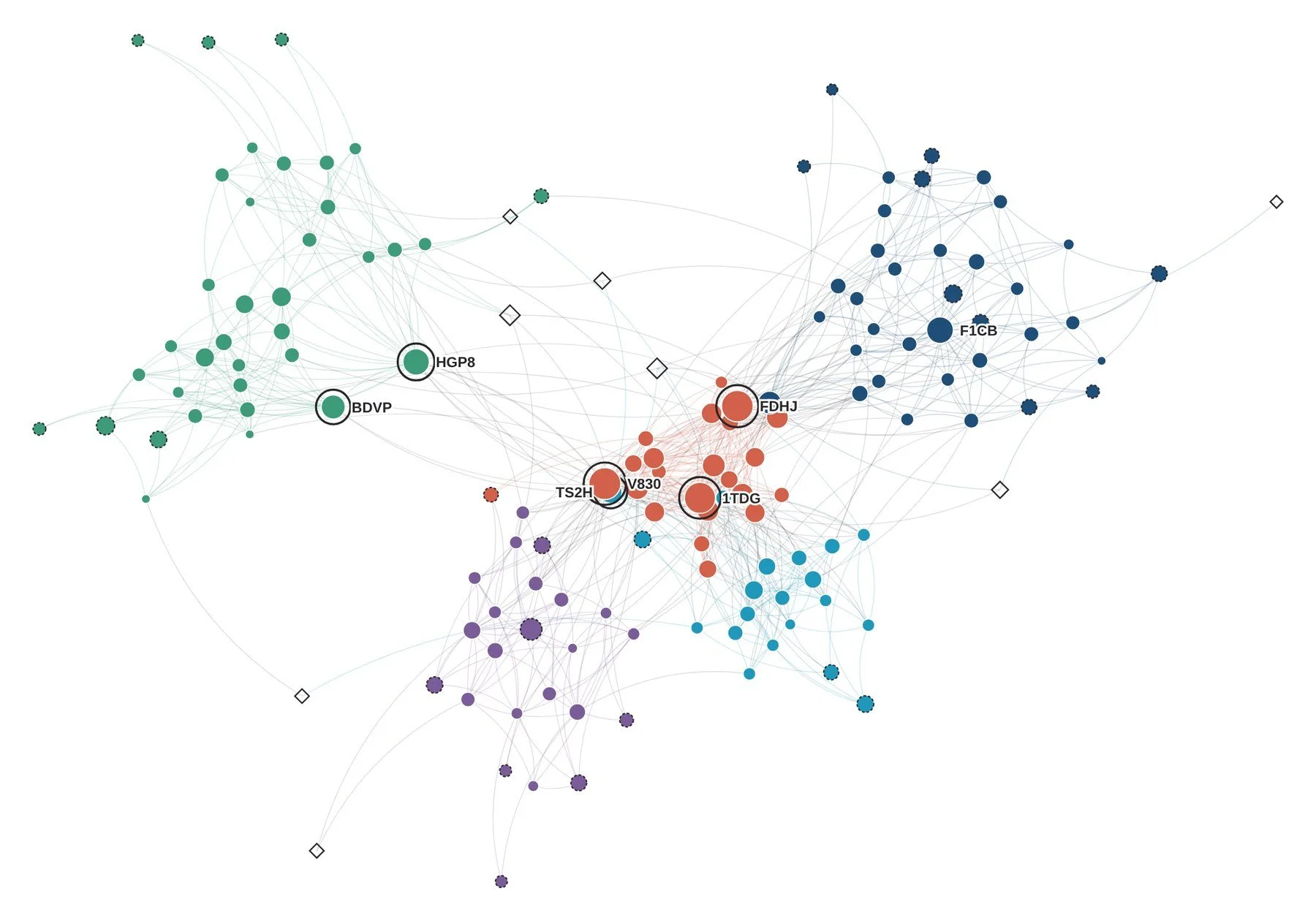
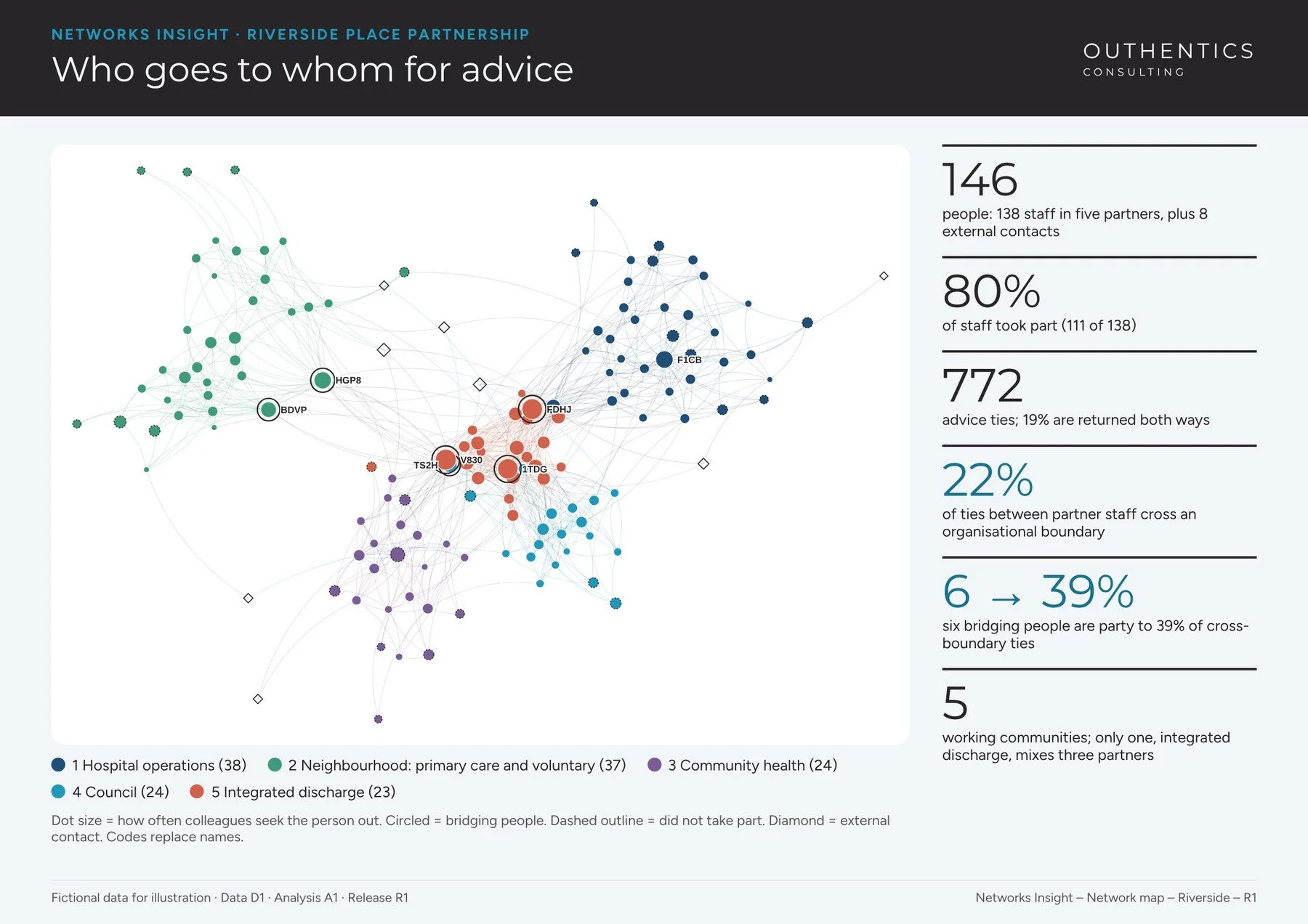
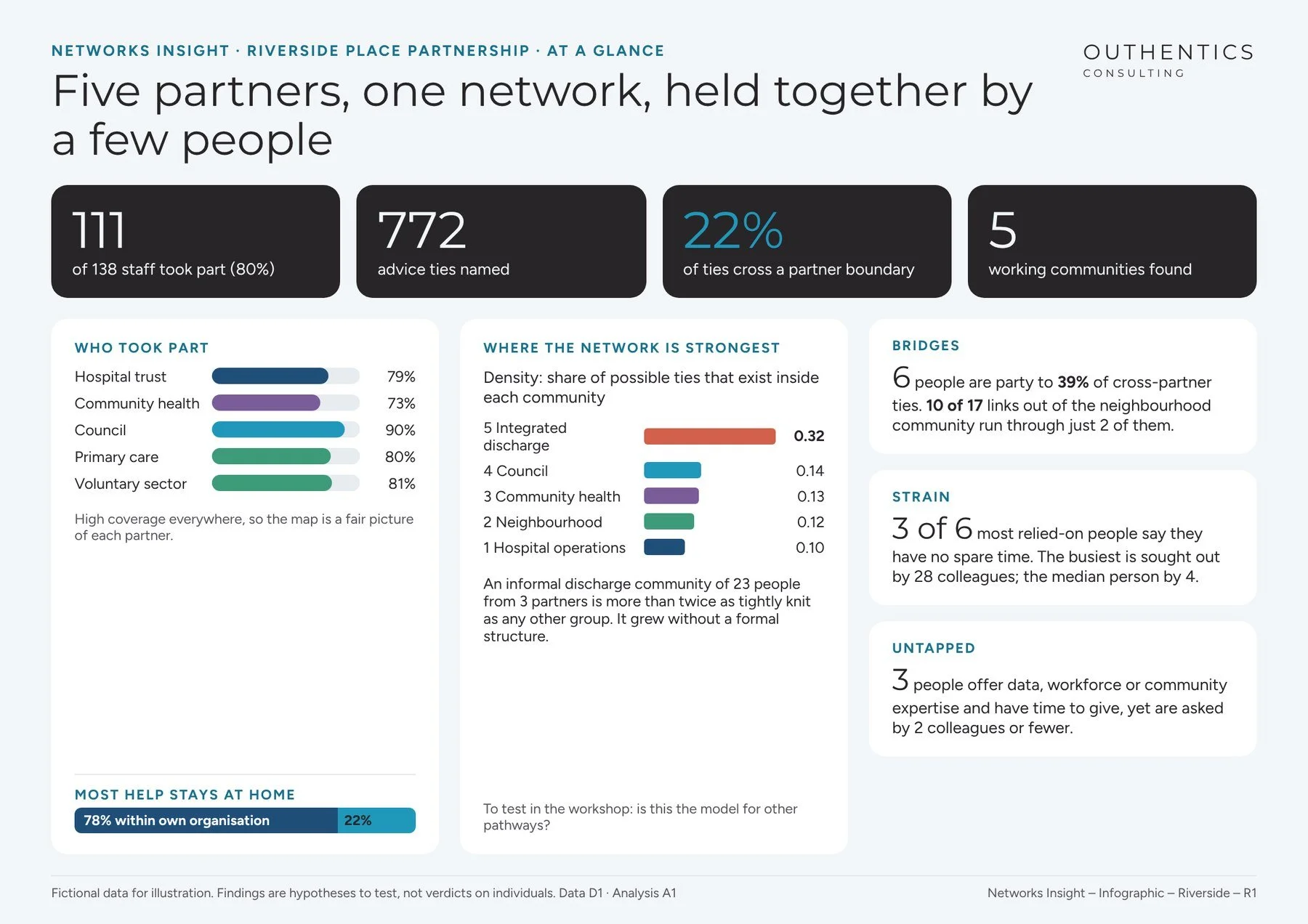
The Riverside Place Partnership is invented. It brings together a hospital trust, a community health provider, a council, a primary care network and a voluntary-sector alliance: 138 staff, 111 of whom (80%) took part, plus eight external contacts they named.
22%
of advice ties between partner staff cross an organisational boundary. Most help stays at home.
6
bridging people are party to 39% of those cross-boundary ties. Lose one and a route closes.
2×+
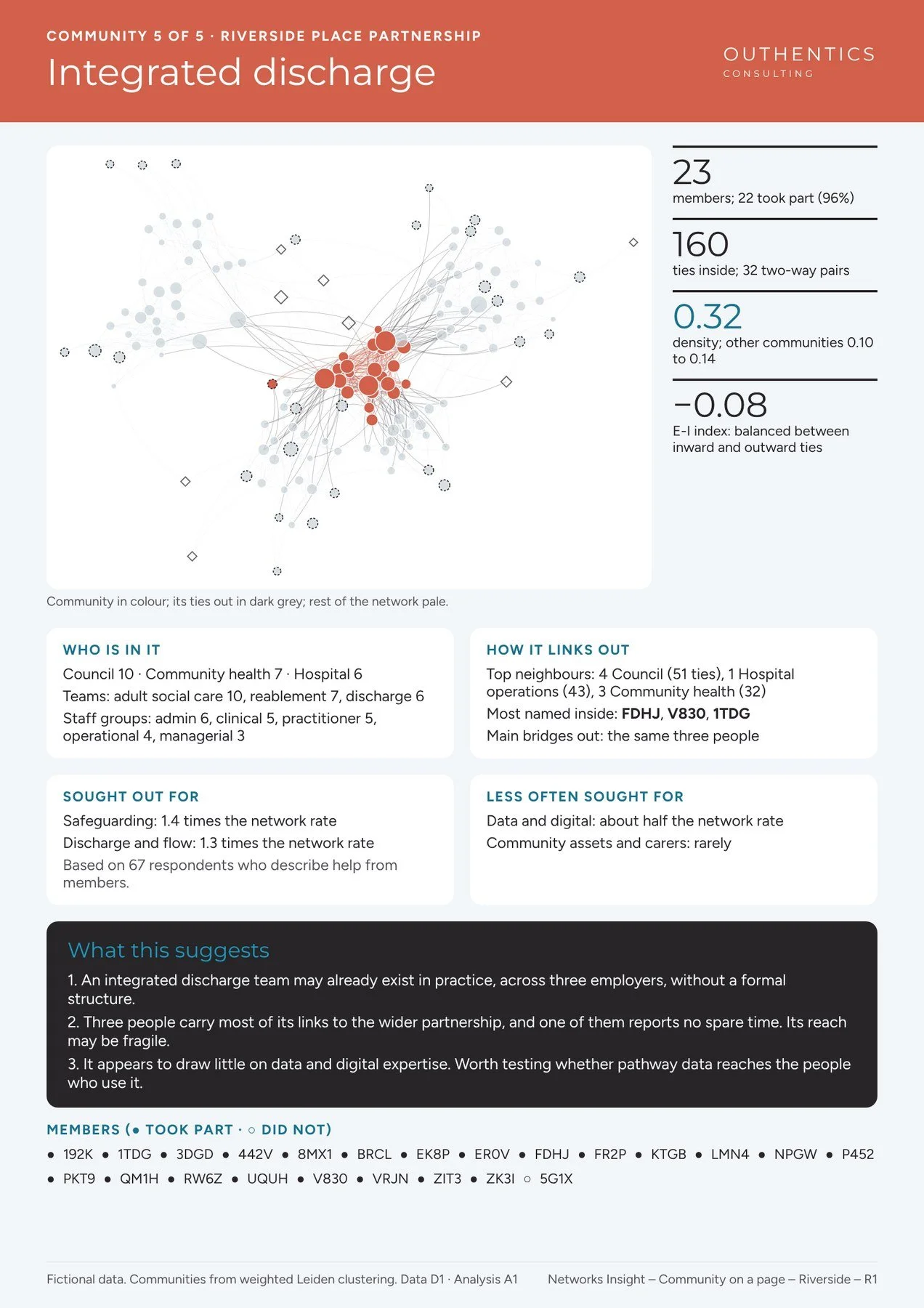
An informal discharge community spanning three partners is more than twice as tightly knit as any other group.
3 of 6
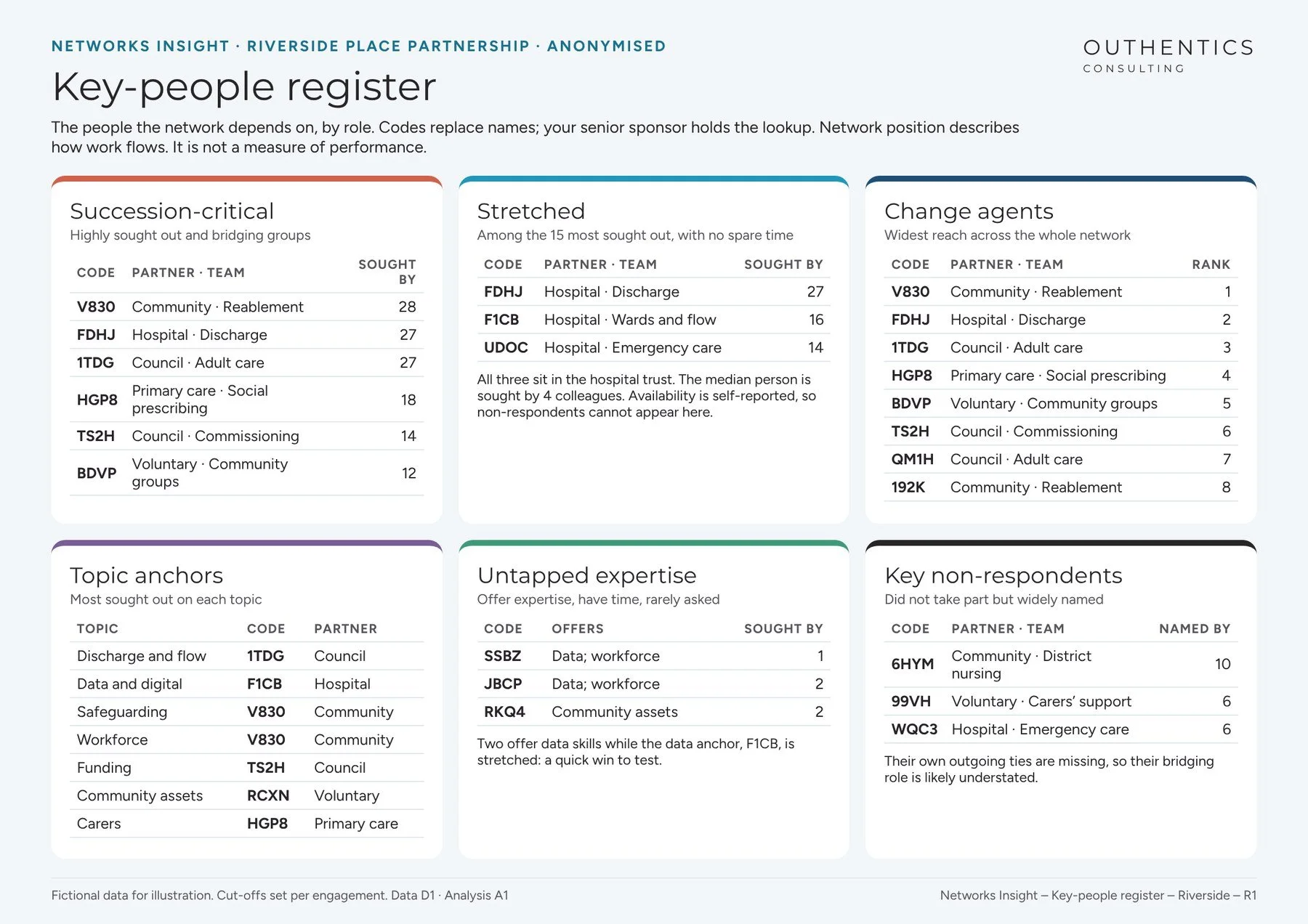
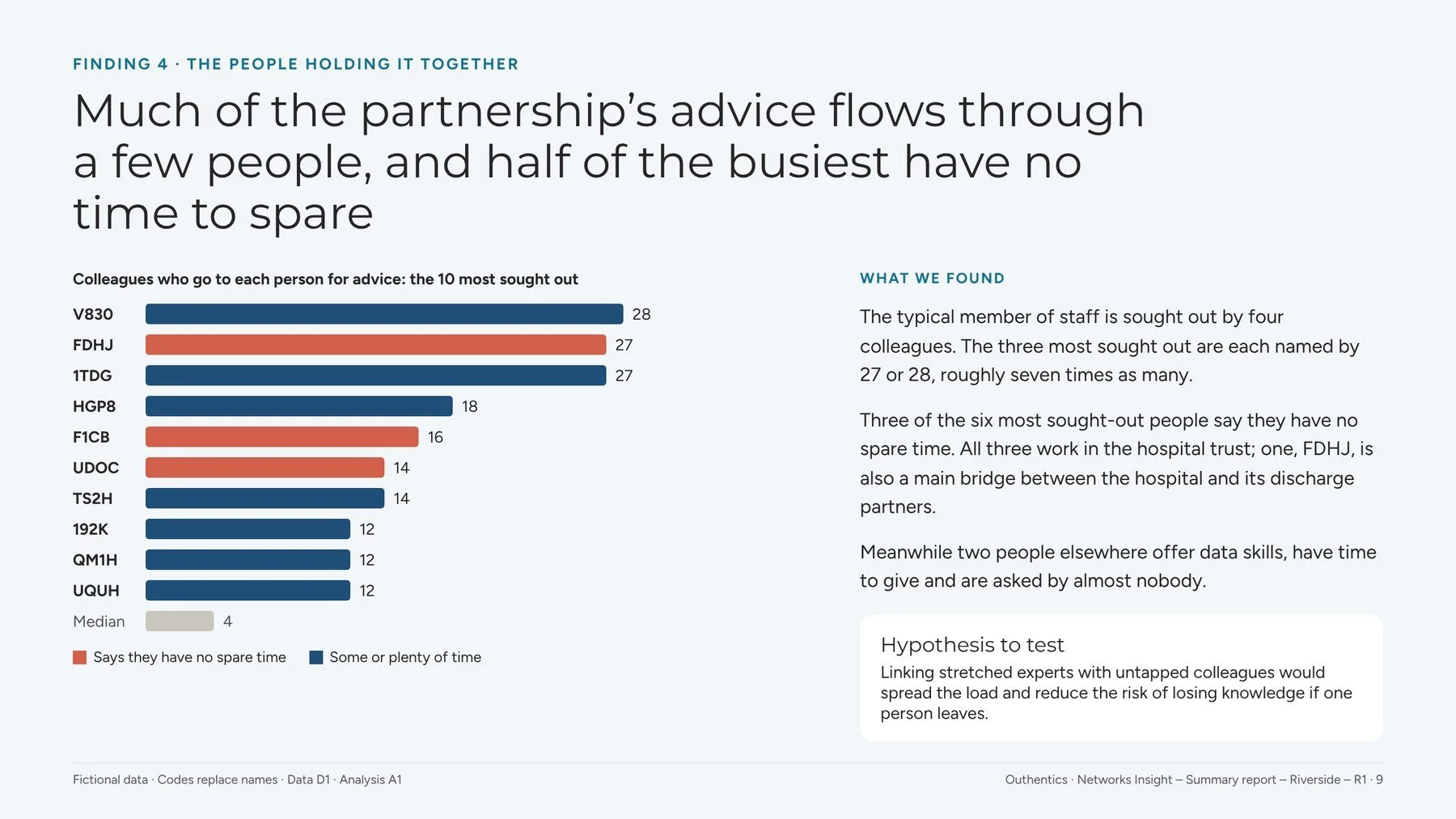
of the most relied-on people say they have no spare time. The busiest is sought out by 28 colleagues; the typical person by four.
10 of 17
links from the primary care and voluntary-sector community to other partners run through just two people.
3
people offer data, workforce or community expertise and have time to give, yet hardly anyone asks them.
See it in action
Explore a partnership’s network yourself
This is the fictional Riverside Place Partnership used in the examples on this page. Switch between views, or tap anyone to see who they turn to and who turns to them.
Or watch the 60-second film
What you receive
Outputs are designed to be used, in boardrooms, team meetings and workshops. The examples below are built from the fictional partnership above.
Example outputs
Built from the fictional Riverside Place Partnership. Click any page to see it full size.
Confidential by design
Anonymous codes, not names
Every shared output uses a four-character code for each person. Names stay in a protected file held by your senior sponsor.
Patterns, not performance
Network position describes how work flows. It is never used to rate individuals, and we say so to staff from the start.
Tested before reported
Patterns are checked for statistical robustness, and findings are offered as hypotheses for staff to confirm or challenge.
Ways to work together
Three starting points. Each is tailored to your questions, and other consultancies can add Networks Insight to their own client work. Ask us for a proposal.
Network health check
For a single organisation or directorate that wants a baseline.
Survey, analysis and maps
Summary report and infographic
One sense-making workshop
Change programme
For a merger, restructure or transformation that depends on relationships.
Everything in the health check
Full report, community profiles and key-people register
Change-agent network set-up and re-measurement
Partnership and system
For integrated care systems, place partnerships and alliances of several organisations.
Cross-boundary analysis and external partners
Guiding-coalition support and OD interventions
Optional personal reports for participants